
AI vs. Traditional Answering Services: A Cost-Benefit Analysis
Somewhere between "just let calls go to voicemail" and "hire a full-time receptionist," most business owners land on a traditional answering service. It feels like a reasonable middle ground. A live human answers your phone, takes a message, and your team calls back when they get a chance.
The problem is that this middle ground was designed for a world before AI receptionists existed. Now that both options are on the table, the math genuinely doesn't favor the older one, and it's worth walking through exactly why before you renew that contract again.
What You're Actually Paying For With a Traditional Answering Service
Traditional answering services typically charge based on call volume or minutes used, which sounds simple until you realize what you're actually paying for. You're paying a stranger, who has never spoken to your customer before and knows nothing about your business beyond a basic script, to take a message and pass it along.
They can't check your calendar. They can't quote your actual pricing with any confidence. They can't answer a question about your service area or your specific process, because they're often handling calls for a dozen other unrelated businesses during the same shift. What you're really buying is a slightly better version of voicemail, delivered by a person instead of a recording.
Cost Scaling as Call Volume Increases
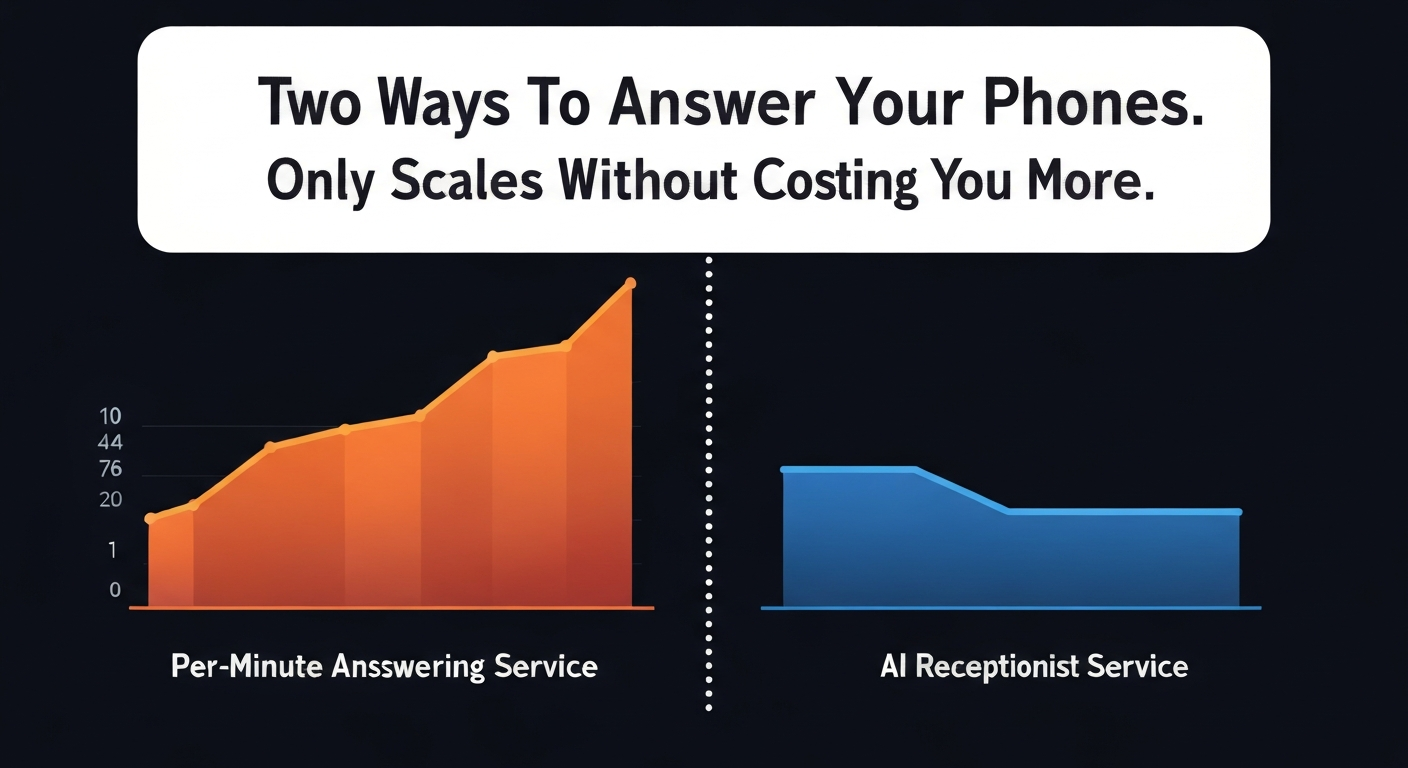
The cost adds up in a way that's easy to overlook. Per-minute or per-call pricing scales with your call volume, which means the busier your business gets, the more expensive this "solution" becomes, at the exact moment you'd expect efficiency to improve, not shrink.
Where the Real Cost Difference Shows Up
A Voice AI Receptionist is priced differently, typically as a flat monthly cost regardless of how many calls come in. That distinction matters more than it sounds, because it means a busy month doesn't quietly cost you more just because more customers tried to reach you.
But the cost comparison isn't only about the invoice. It's also about what each option can actually do once someone picks up the phone.
| Capability | Traditional Answering Service | AI Receptionist |
|---|---|---|
| Pricing Structure | Per-minute or per-call, scales with volume | Flat monthly cost |
| Knowledge of Your Business | Basic script only | Trained on your services, pricing, FAQs |
| Can Book Appointments Directly | Rarely, usually just takes a message | Yes, checks live calendar and books |
| Updates Your CRM Automatically | No, requires manual entry after the call | Yes, logged automatically |
| Availability | Live agents, but often limited hours or add-on cost for 24/7 | 24/7 as standard |
Compare what you're currently paying against what an AI receptionist would actually cost.
Book a Free AI Strategy Call →The Hidden Labor Cost Nobody Includes in the Comparison
Here's the part most owners forget to calculate. When a traditional answering service takes a message, that message still needs to go somewhere. Someone on your team has to review it, call the customer back, confirm details, and manually schedule the appointment or follow-up.
That's not free labor. It's staff time that gets spent reacting to messages instead of doing anything else, and it introduces a delay between the original call and the actual callback, during which the customer may have already found another business willing to answer directly.
An AI receptionist removes this middle step entirely. Because it can check your calendar and book appointments in real time during the original call, there's no message to relay and no callback loop required. The conversation starts and finishes in a single interaction, which is where a large part of the actual cost savings comes from, not just the monthly invoice itself.
Why Call Quality Tends to Diverge the Longer You Use Each Option
In the first few weeks, a traditional answering service and an AI receptionist might feel similarly capable, since both are simply answering the phone. The difference becomes obvious over time.
A human answering service agent handling calls for dozens of unrelated businesses has no reason or ability to get better at representing your business specifically. The script stays generic because it has to, in order to work across every client they serve.
An AI receptionist, by contrast, is trained specifically on your business and gets refined over time based on real call transcripts and outcomes. This is where Workflow Automation plays a quiet but important role, connecting every call outcome back into your CRM so patterns in customer questions or booking behavior can actually inform how the AI responds going forward, something a shared answering service pool has no mechanism to do.
Making the Switch Without Disrupting What Already Works
Moving away from a traditional answering service doesn't require dropping your current setup cold turkey. Every AI receptionist BayksCloud builds runs natively inside GoHighLevel, connected to your calendar and CRM, so the transition can happen alongside your existing process until you're confident it's handling calls the way you want.
The typical path looks like this:
- A discovery call reviewing your current answering service contract, call volume, and where it falls short
- Custom training on your specific business, pricing, and FAQs
- A side-by-side testing period where you compare real call handling before fully switching
- Launch within 72 hours once all requirements are gathered
If you want to hear the difference directly, you can start a 14-Day Free Trial and compare it against your current answering service before making a final decision.
Biggest Takeaways
- Traditional answering services typically price by call volume, meaning your busiest months cost the most, not the least
- A human agent working across multiple unrelated businesses can't book appointments or access your real calendar
- The hidden cost of a traditional service is the staff time spent manually returning every message afterward
- AI receptionists improve over time through real call data, while shared answering services stay generic by design
- Switching can happen gradually, running alongside your current setup until you're confident in the transition
See exactly how the numbers compare for your specific call volume.
Book Your Free AI Strategy Call Today →Cost-Benefit Calculator
See exactly how much a traditional answering service is costing you compared to an AI Voice Receptionist.
Your Current Call Volume
Adjust the sliders to match your business metrics.
Staff time spent manually calling back customers who left messages.
Traditional Cost
$3,000/mo
Includes $750 in hidden labor
AI Receptionist
$225/mo
Fully automated, zero callbacks
Your Estimated Savings
$2,775
saved every single month
That's $33,300 back in your pocket this year.
Book Free AI Strategy CallKey Takeaways
- AI automation directly impacts your bottom line by capturing leads and booking appointments that would otherwise go to competitors.
- Implementing AI doesn't replace your staff; it frees them from repetitive tasks so they can focus on high-value customer interactions.
- Speed to lead is critical in local services. AI ensures a 24/7 instant response across voice, web chat, and SMS.

Written by Eric Adjei
Eric Adjei is an AI & Digital Marketing Strategist and Business Coach with over 20 years in the IT and digital marketing space, and founder of BayksCloud Consultants LLC - a digital marketing agency in the Miami–Fort Lauderdale metro area, South Florida. He specializes in helping Managed IT Services (MSPs), Medical Spas (Medspas), and HVAC companies replace manual operations and missed leads with AI employees, intelligent CRM systems, and digital marketing strategies that work around the clock.
Book a Free AI Strategy Call →Voice AI
Every missed call is a customer you might never get back.
Most people don't leave voicemails. They hang up and call someone else.
- Answers inbound calls for you, even after hours
- Qualifies leads, handles FAQs and books appointments automatically
- Sounds natural and captures every opportunity in your CRM
Related Articles

AI Appointment Setter 101: How to Book Jobs on Autopilot (2026 Guide)
What an AI appointment setter is, what it does from first contact to booked job, how it differs from an AI receptionist, and how to set one up the right way.

Do You Really Need an AI Receptionist? Here's the Truth (2026 Data)
An honest look at 2026 data on missed calls and AI receptionists: what the numbers really say, what an AI receptionist should do, and how to decide if you need one.
Why Small Businesses Fail to Follow Up (And Why It's Never About Effort)
Poor follow-up isn't a discipline problem. Here's the real structural reason leads and customers slip through the cracks, and how to fix it.
Ready to implement AI in your business?
Book a free strategy call to see how an AI receptionist can stop your revenue leaks.
Book Free AI Strategy Call